 HybridPPM.com
Understanding PPM: project, program and portfolio management explained
PPM is how an organization chooses the right work, organizes it, and delivers it well. This guide explains each way of running a project (predictive, Agile, hybrid, Kanban and Scrumban), how programs and portfolios sit above projects, and the governance that ties them together.
Temporary work that produces a product, service or result, run in whichever way suits the work.
Related projects managed together to deliver benefits they couldn’t deliver on their own.
All the work an organization invests in, selected and balanced to deliver its strategy.
Predictive Project Management (Waterfall)
Predictive project management plans the whole job up front and then delivers to that plan. It works best when the requirements are well understood, change is costly, and the outcome can be described in detail before work starts: buildings, regulated systems, equipment installs, events with a fixed date.
The core idea
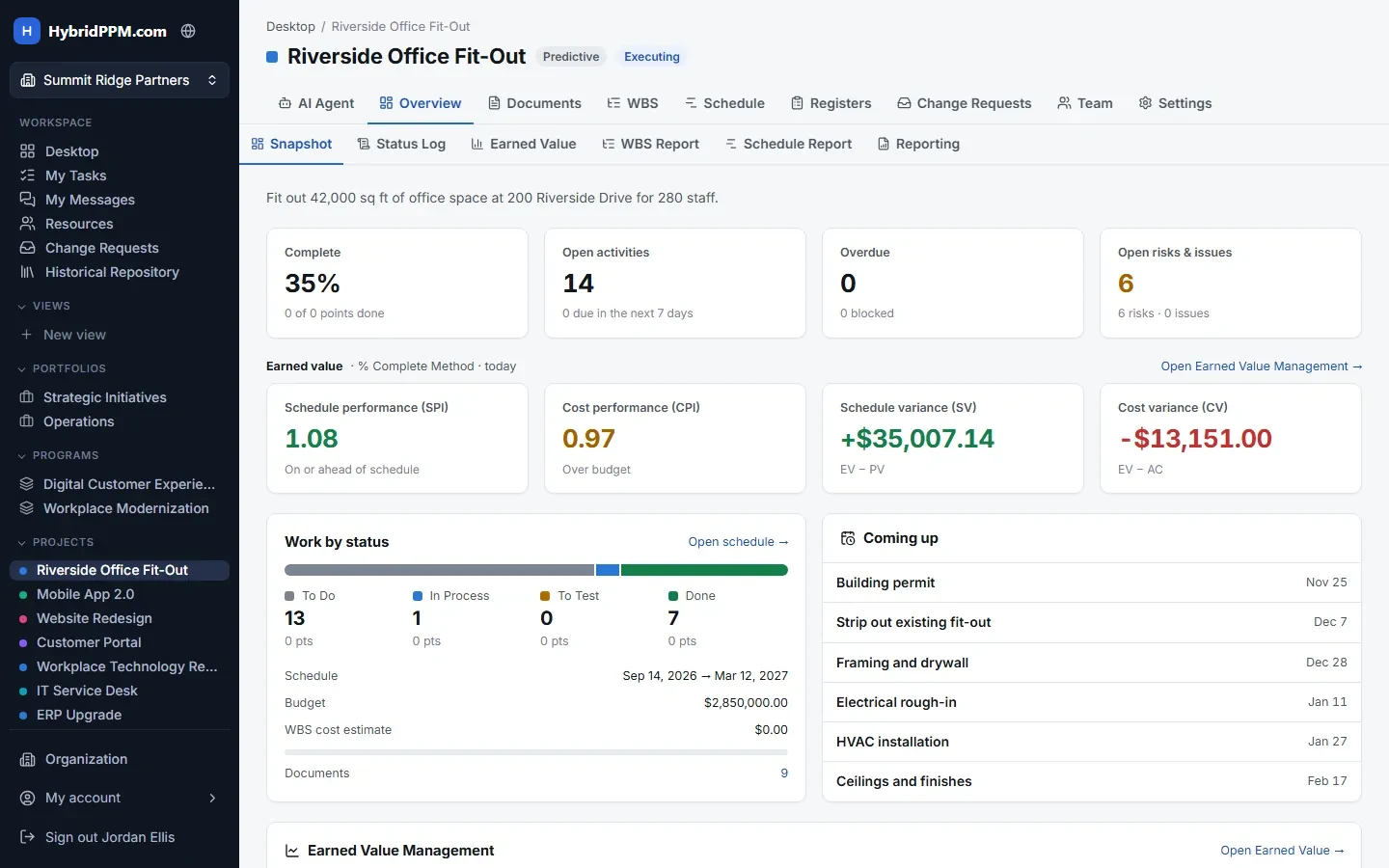
Scope, schedule and cost are defined early and set as a baseline. The team then executes, and the project manager measures progress against that baseline and controls changes to it. Value usually arrives at the end, when the finished deliverable is handed over.
The life cycle
- Initiating: confirm why the project exists, who sponsors it and what success means; authorize it with a charter.
- Planning: break the scope down into a work breakdown structure (WBS), estimate, sequence the activities, build the schedule and budget, and plan for risk, quality, resources, communications and procurement.
- Executing: do the work, manage the team, engage stakeholders and buy what is needed.
- Monitoring and controlling: compare actual progress with the baseline, forecast the finish, and decide on changes through a formal change control process.
- Closing: accept the deliverables, release the resources, close contracts and record lessons learned.
How the work is structured
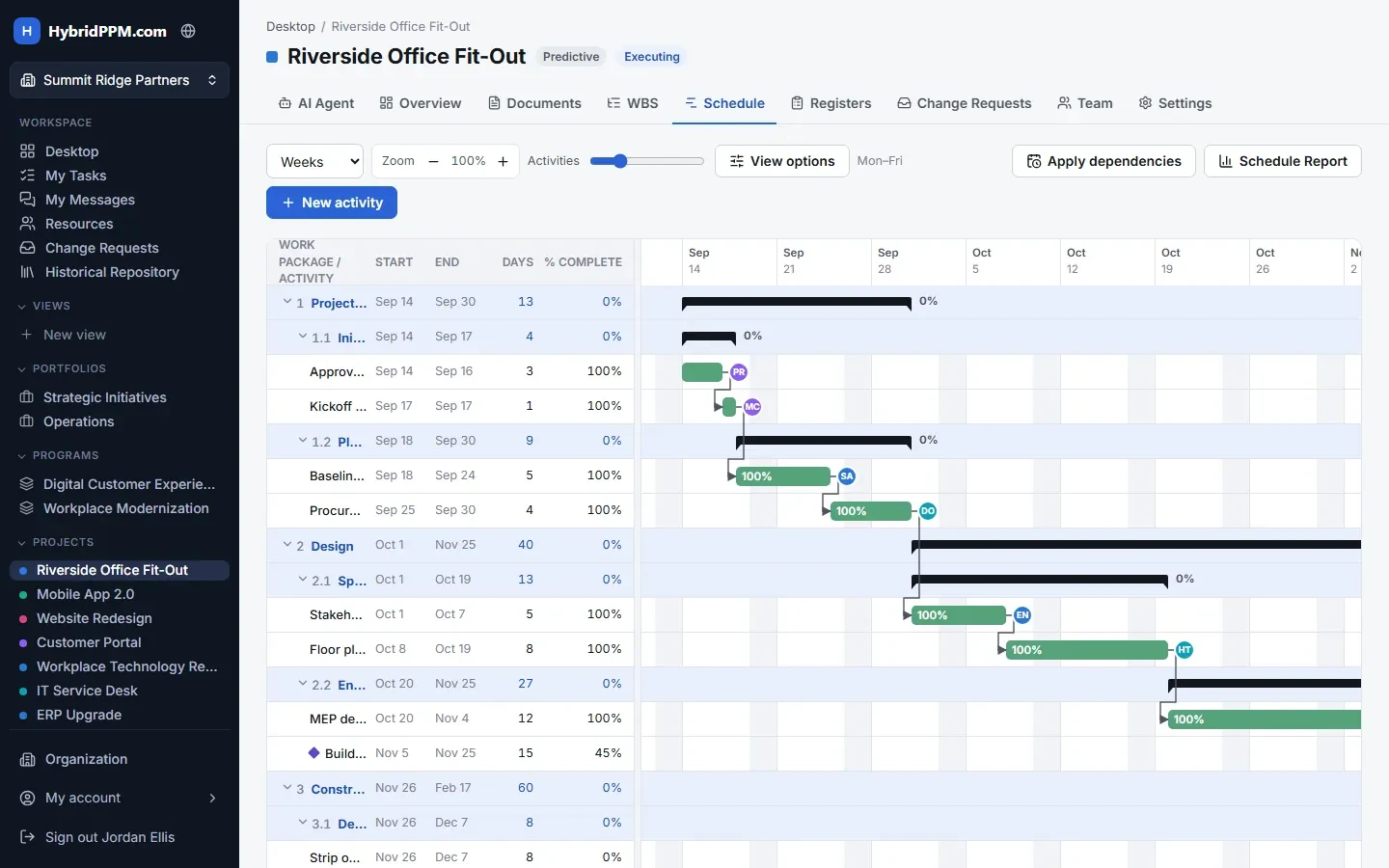
The WBS divides the total scope into smaller deliverables until each work package can be estimated and assigned. Activities under the work packages are linked by dependencies (finish-to-start is the most common), which gives the critical path: the longest chain of dependent work, and therefore the shortest possible duration. Any delay on the critical path delays the finish.
Measuring performance
Earned value management (EVM) combines scope, schedule and cost into one view. It compares what was planned (planned value), what was actually completed (earned value) and what it actually cost (actual cost).
- SPI
- Schedule performance index = EV ÷ PV. Below 1.0 means behind schedule.
- CPI
- Cost performance index = EV ÷ AC. Below 1.0 means over budget.
- EAC
- Estimate at completion: what the whole project is now expected to cost.
- Baseline
- The approved version of the scope, schedule and budget that progress is measured against.
Strengths and watch-outs
- Strengths: clear commitments, early visibility of cost and dates, and strong control where safety, contracts or regulation demand it.
- Watch-outs: late feedback (users may not see the result until the end), and change is expensive once the baseline is set. Plans need regular, honest re-forecasting.
Today’s view of the standard
The current PMBOK® Guide treats project management as a system for delivering value. It describes a small set of principles (such as a holistic view, a focus on value, built-in quality, accountable leadership, sustainability and an empowered culture), performance domains (governance, scope, schedule, finance, stakeholders, resources and risk) and focus areas that follow the familiar initiating-to-closing flow. Every project tailors these to its own context.
Predictive (Waterfall) in HybridPPM
- Schedule: the WBS, Gantt chart, dependencies, critical path and baselines.
- Earned Value on the project Dashboard, with SPI, CPI and forecasts.
- Change requests, risk and issue registers, the RACI matrix and the Status Log.
Adaptive Project Management (Agile)
Adaptive (agile) project management delivers in short cycles and learns as it goes. It fits work with high uncertainty, where the right answer is discovered by building something, showing it to the people who will use it, and adjusting.
The core idea
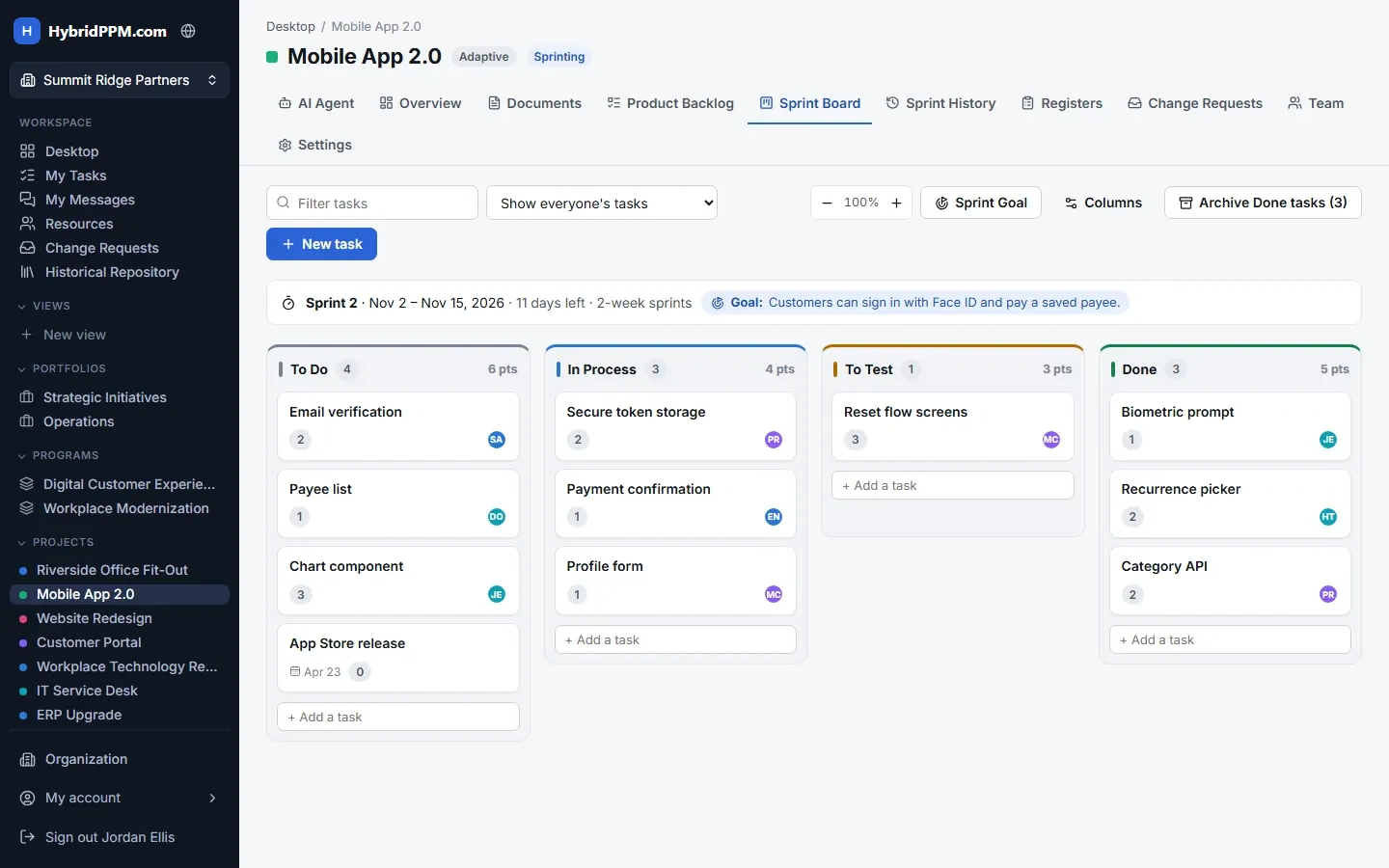
Instead of fixing the scope and estimating the time and cost, agile fixes the time and team (a sprint of one to four weeks) and lets the scope flex. The most valuable work is done first, so useful results arrive early and often, and feedback shapes what comes next.
Values and mindset
- People and collaboration over heavy process.
- Working results over exhaustive documentation.
- Working with the customer over negotiating with them.
- Responding to change over sticking to an outdated plan.
- Psychological safety: teams improve fastest when people can raise problems without fear.
Roles in a typical Scrum team
- Product owner
- Owns the product backlog and decides what is most valuable to build next.
- Team facilitator (Scrum Master)
- Serves the team: removes impediments, coaches the practices and protects focus.
- Development team
- A small, cross-functional group that has all the skills needed to deliver each increment. Generalizing specialists (deep in one skill, able to help in others) keep work flowing.
The rhythm of a sprint
- Backlog refinement: keep the top of the backlog clear, small and estimated (often in story points).
- Sprint planning: choose a sprint goal and pull in the work the team can finish.
- Daily stand-up: a short check on progress toward the goal and anything blocking it.
- Sprint review: show the finished increment to stakeholders and gather feedback.
- Retrospective: agree one or two improvements to how the team works.
Planning beyond the sprint
Epics break down into features and user stories. A story map arranges them along the user’s journey and slices them into releases, so the team can plan a minimum viable product and later increments without fixing every detail up front.
Measuring progress
- Velocity: the story points finished per sprint, used for forecasting, never for comparing teams.
- Burndown and burnup charts: work remaining or completed over time against the target.
- Definition of Done: the shared checklist that makes “done” mean the same thing to everyone.
- Outcome measures: customer satisfaction, usage and business value, not just output.
Adaptive (Agile) in HybridPPM
- Story Map with releases, the Product Backlog and the Sprint Board.
- Sprint goals, capacity, stand-ups, reviews and retrospectives.
- BurnUp, BurnDn, Agile Metrics and Sprint History.
- Team tab: a team charter and anonymous team check-ins; Agile Metrics: software delivery (DORA) measures from GitHub.
Hybrid Project Management (Predictive + Adaptive)
Hybrid project management combines predictive and adaptive practices in one project, choosing the right approach for each part of the work. Most real projects are hybrid: some parts are fixed and well understood, while others need discovery.
Why hybrid
A single approach rarely fits everything. A new store opening has a fixed date, building works and contracts (predictive), but the customer app and in-store experience benefit from iteration (adaptive). Hybrid lets each part use what suits it, while the project still reports as one.
Common patterns
- Predictive frame, agile delivery: plan phases, milestones and the budget up front, then build the deliverables inside each phase in sprints.
- Agile discovery, predictive rollout: prototype and test iteratively, then roll out the chosen solution to a fixed plan.
- Side by side: some workstreams run on a schedule while others run on a board, joined by shared milestones.
Choosing the approach for each part
- How clear and stable are the requirements? Clear and stable points to predictive; unclear or changing points to adaptive.
- Can the work be delivered and used in pieces? If so, incremental delivery adds value early.
- How costly is change late in the work? High cost of change favours up-front design.
- What do contracts, regulation and safety require? Formal approvals often need predictive gates.
- How experienced is the team with each approach, and how available are the customer and users for feedback?
Making it work
- Tailor on purpose: decide which practices each part uses, write it down and review it.
- Keep one view of progress: link sprint results to the schedule’s milestones so sponsors see a single picture.
- Translate measures: story-point progress and earned value can both feed the same status report.
- Govern with lightweight gates: approve the funding and direction at milestones, and let teams adapt the detail between them.
Hybrid in HybridPPM
- Hybrid projects have both a Schedule and a Sprint Board.
- Schedule tasks can be planned into sprints, and the sprint roadmap sits beside the board.
- Earned value and agile charts appear together on the Dashboard.
- Settings → Tailoring: a suitability check that scores each approach, and a record of which practices the project uses, adapts or leaves out.
Kanban (pull-based)
Kanban is a way to manage a continuous flow of work. Instead of planning in sprints, the team pulls the next item when it has capacity, and keeps the amount of work in progress deliberately small so items finish quickly.
The core practices
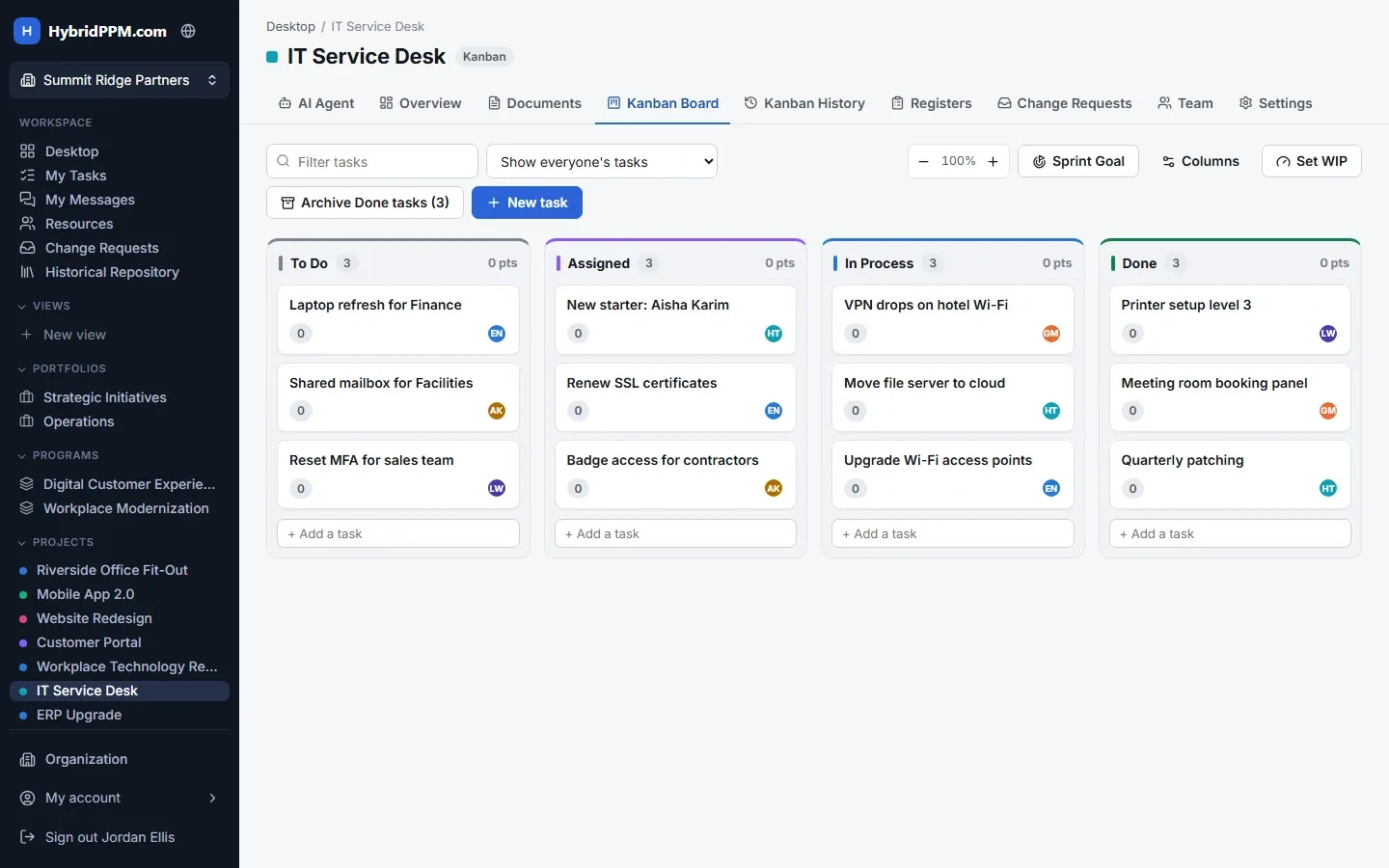
- Visualize the work: a board with a column for each step, from “to do” to “done”.
- Limit work in progress (WIP): each column has a limit; when it’s full, the team helps finish work before starting more.
- Manage the flow: watch where work waits or piles up, and fix the bottleneck.
- Make policies explicit: agree what “ready” and “done” mean for each column.
- Use feedback loops: regular replenishment, delivery and review meetings at a cadence that suits the work.
- Improve together, evolve by experiment: change the process in small steps, based on data.
Why limiting WIP works
Starting less finishes more. When fewer items are in progress, each one spends less time waiting, problems surface sooner and people switch tasks less. Little’s Law captures this: average cycle time equals work in progress divided by throughput.
Flow measures
- Cycle time
- How long an item takes from starting work to done.
- Lead time
- How long from the request to delivery, including the wait before work starts.
- Throughput
- How many items finish per week.
- Work item age
- How long an unfinished item has been in progress; old items are a warning sign.
- Service level expectation (SLE)
- The cycle time the team aims to beat for most items, such as “85% within 8 days”.
- Cumulative flow diagram
- Bands for each column over time; widening bands show a bottleneck.
Where it fits
Kanban suits work that arrives continuously and varies in size: support and operations, maintenance, marketing requests, and teams whose priorities change daily. It can be applied to an existing process without reorganising roles, which makes it an easy place to start.
Kanban in HybridPPM
- The Kanban Board with WIP limits, work item age and blocked flags.
- The service level expectation in the project settings.
- Flow metrics and Kanban History.
Scrumban (Agile + Kanban)
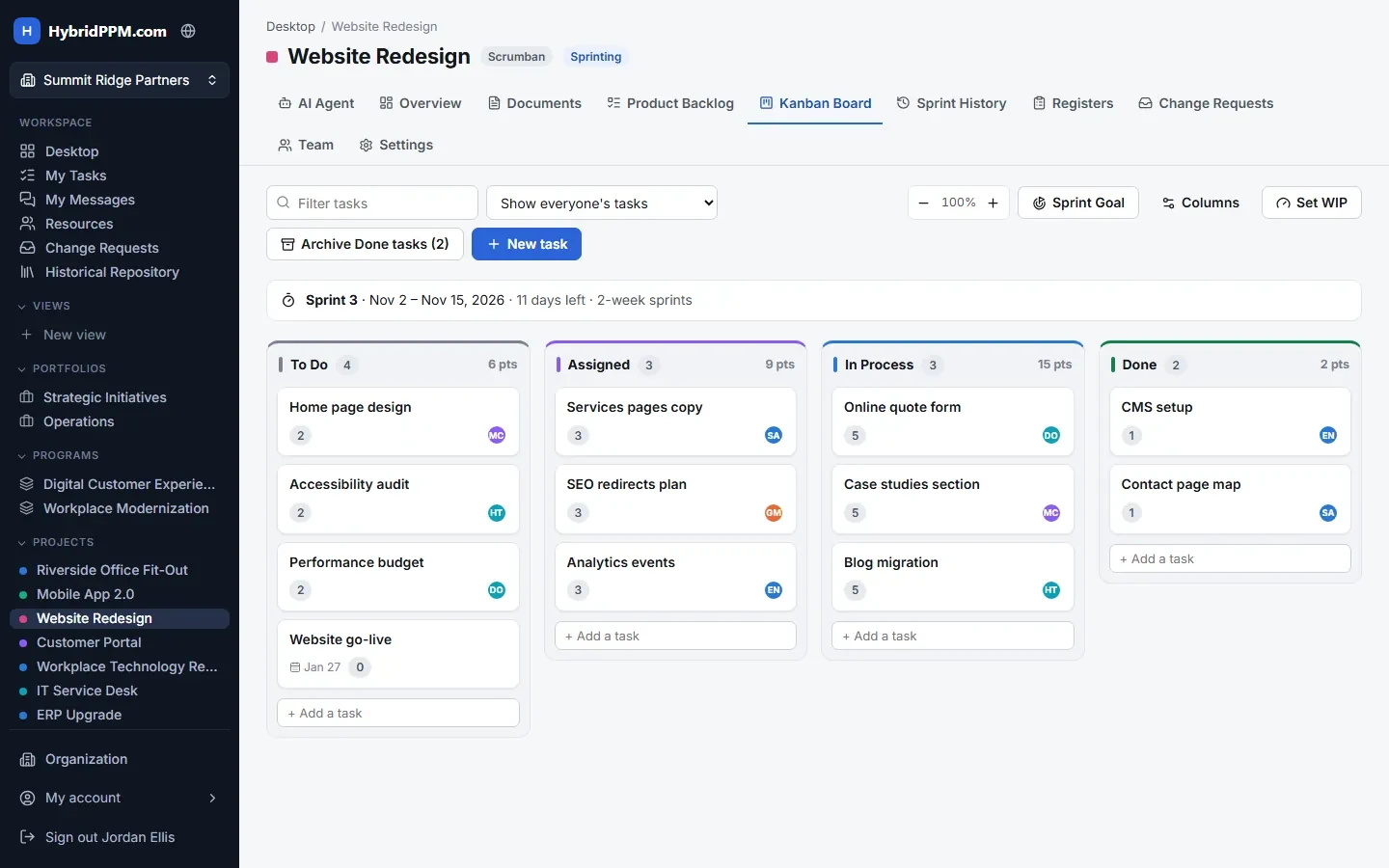
Scrumban combines Scrum’s planning rhythm with Kanban’s flow control. Teams keep regular planning and review cycles, but manage the work on a WIP-limited board and pull new items as capacity frees up.
What it takes from each
- From Scrum: a prioritized backlog, regular planning, reviews with stakeholders and retrospectives.
- From Kanban: WIP limits, pull instead of push, explicit policies and flow measures such as cycle time.
How a Scrumban team works
- The backlog is refined and ordered as usual.
- Planning happens on a cadence, or when the “ready” column runs low, rather than committing to a fixed sprint scope.
- Work is pulled through the board within WIP limits.
- Reviews and retrospectives still happen on a regular rhythm.
When to choose it
- A Scrum team is frequently interrupted by urgent work that can’t wait for the next sprint.
- A Kanban team wants more structure for planning and for reviewing with stakeholders.
- A team is moving from one approach to the other and wants a gradual transition.
Watch-outs
Without discipline, Scrumban can lose the commitment of a sprint goal and the focus of WIP limits at the same time. Keep the limits visible, keep the cadence of reviews and retrospectives, and use flow data to decide what to change.
Scrumban in HybridPPM
- Scrumban projects have a Story Map, Product Backlog and a board with WIP limits.
- Sprint History records what each cycle delivered.
Program Management
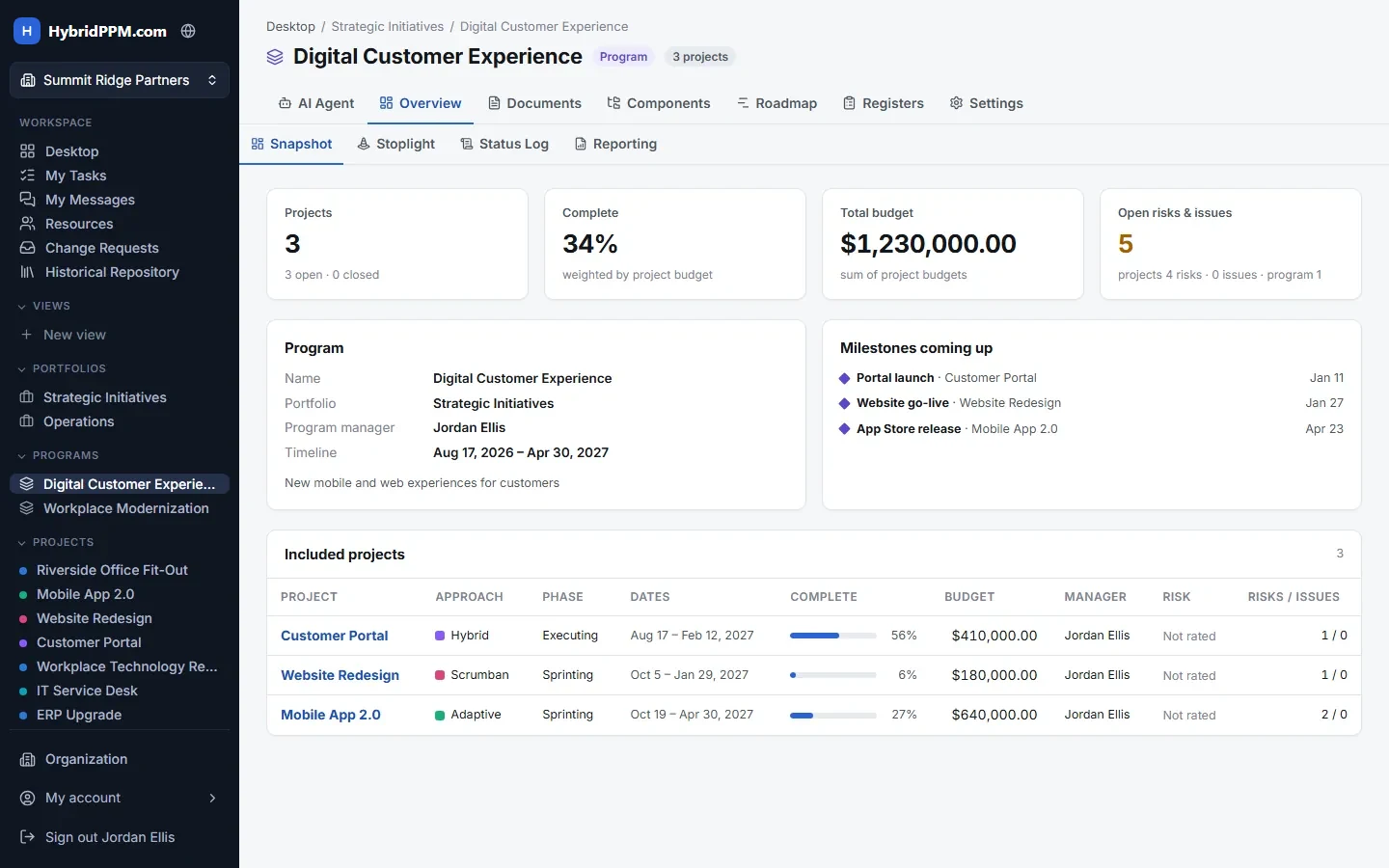
A program is a group of related projects and other work managed together to deliver benefits that they couldn’t deliver on their own. Program management coordinates those components so that their combined outcome serves the organization’s strategy.
Programs versus projects
- A project produces outputs: a product, service or result.
- A program delivers benefits: the lasting improvements those outputs make possible, such as higher revenue, lower cost or better service.
- Projects have a fairly fixed scope; a program’s scope evolves as the benefits become clearer and the environment changes.
Principles of program management
- Stakeholders: engage everyone affected by the change, not just the sponsor.
- Benefits realization: plan, deliver and sustain the benefits, and measure them after the projects close.
- Synergy: manage the components together so the whole is worth more than the parts.
- Team of teams: align many teams around shared goals.
- Change: help the organization adopt new ways of working.
- Leadership, risk and governance: steer through uncertainty with clear authority and decision making.
Performance domains
- Strategic alignment
- Keep the program tied to the organization’s goals as both evolve.
- Benefits management
- Identify, plan, deliver, transition and sustain the benefits.
- Stakeholder engagement
- Understand and work with the people the program affects.
- Governance framework
- Decision rights, gates, reviews and escalation for the program.
- Collaboration
- Coordinate across components, teams and partners.
- Life cycle management
- Move the program through definition, delivery and closure.
The program life cycle
- Definition: build the business case, the program charter and the roadmap; set up governance and the benefits plan.
- Delivery: start, oversee and integrate the component projects; manage dependencies, shared resources, risks and changes; transition the benefits to operations.
- Closure: confirm the benefits are delivered or handed over to someone who will sustain them, and close the program formally.
Roles
- Program sponsor
- Champions the program, secures the funding and is accountable for its benefits.
- Program manager
- Coordinates the components and is responsible for delivering the program’s outcome.
- Program management office
- Supports the program with standards, reporting, resource coordination and governance.
Program Management in HybridPPM
- Programs group projects, with a roadmap, components and an increment board.
- The program Dashboard rolls up schedule, cost, risk and status from its projects.
- The Stoplight, Status Log and Reporting tabs track the program as a whole.
- Benefits map from outputs to outcomes, benefits and objectives, with an operations owner and measurement reminders after the work closes.
- Roadmap → Dependency map: a network of which project waits on which, including agreements from the Dependency registers.
- Registers: a Communications Plan beside the stakeholder register and its engagement matrix.
Portfolio Management
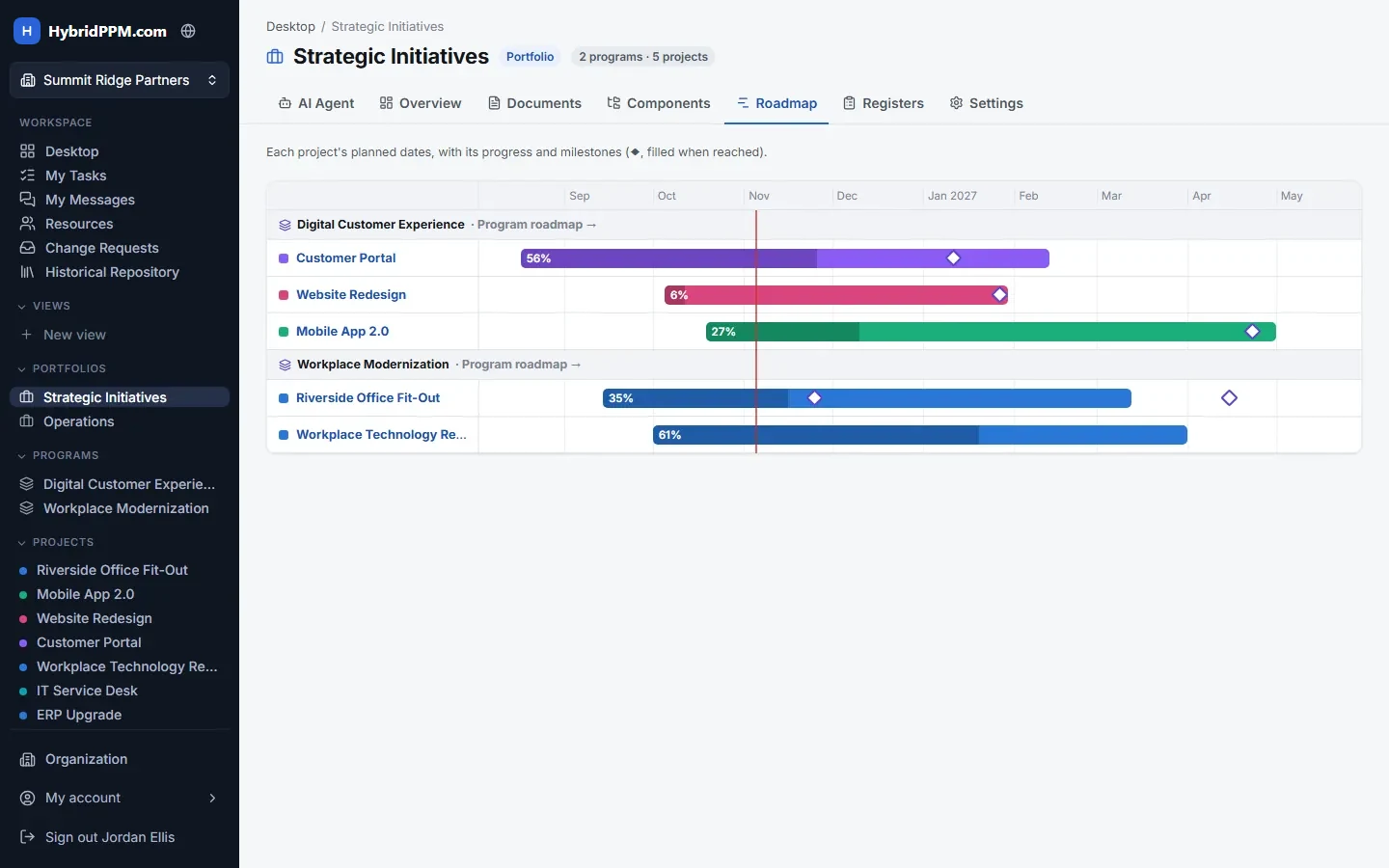
A portfolio is the collection of programs, projects and operations an organization invests in to achieve its strategy. Portfolio management decides which work to do, in what order and with what resources, so that the organization gets the most value from limited capacity.
Doing the right work
Project and program management are about doing the work right. Portfolio management is about doing the right work: selecting, prioritizing and balancing investments, and stopping work that no longer serves the strategy.
The portfolio life cycle
- Initiation: link the portfolio to the strategy and set up its structure, roles and governance.
- Planning: define the selection criteria, the roadmap and the balance between kinds of work.
- Execution: evaluate, select, authorize and monitor components, and rebalance as conditions change.
- Optimization: continually adjust the mix to maximise value within capacity and risk appetite.
Key practices
- Strategic management
- Translate strategy into objectives and criteria for choosing work.
- Governance
- Make, review and enforce investment decisions at the portfolio level.
- Capacity and capability
- Match the demand for people, skills and money with what is actually available.
- Stakeholder engagement
- Keep executives and business owners informed and involved in trade-offs.
- Value management
- Define, measure and maximise the value the portfolio delivers.
- Risk management
- Manage risk across the whole portfolio, including concentration and dependencies.
Prioritizing and balancing
- Score candidates against weighted criteria: strategic fit, value, cost, risk and urgency.
- Balance the mix: run, grow and transform; short and long term; low and high risk.
- Respect capacity: starting more work than the organization can staff slows everything down.
- Review regularly: rebalance as the strategy, the market and the results change.
Lean and agile portfolios
Many organizations now fund long-lived value streams or product teams instead of individual projects, and review the investment on a regular cadence using evidence of the outcomes. This keeps the portfolio responsive without losing control of the spending.
Portfolio Management in HybridPPM
- Portfolios group programs and projects, with a strategy, roadmap and components.
- The portfolio Dashboard and Stoplight show health and budget across all its work.
- The Enterprise PMO’s Planning and Capacity pages support prioritization and resource balancing.
- Portfolio → Strategy: measurable objectives, alignment, and gaps where no work serves an objective.
- Strategy → Balance: run, grow and transform mix against targets, and rebalancing reviews (continue, accelerate, pause, stop).
- Strategy → Value streams: lean funding for long-lived streams of work, with guardrails and funding reviews.
PPM Governance and the Enterprise PMO
Governance is the framework of decision rights, policies and oversight that keeps portfolios, programs and projects aligned with the organization’s strategy. It answers: who decides, on what basis, how decisions are communicated, and how results are checked.
Three levels that work together
- Portfolio governance
- Decides which programs and projects to fund, sets priorities, allocates capacity and stops work that no longer adds value. It is usually led by an executive or investment board.
- Program governance
- Oversees a program’s benefits, its roadmap and the coordination of its components, and authorizes components to start and to move through their gates. It is usually led by a program board with the sponsor.
- Project governance
- Approves the project’s plans and baselines, decides on changes beyond the project manager’s authority, and accepts the deliverables at each gate. It is usually led by a sponsor or steering committee.
How decisions flow
Direction flows down and information flows up. The portfolio sets the strategic priorities and funding. Programs and projects turn them into plans and report performance, risks and issues back. Each level decides within its own thresholds and escalates anything beyond them, so decisions are made at the right level and quickly.
What governance covers
- Alignment: every component traces back to a strategic objective.
- Risk: tolerances are set from the top and risks are escalated when they exceed them.
- Performance: consistent measures and health checks, so results can be compared and rolled up.
- Communications: the right information reaches decision makers in time to act.
- Oversight, control, integration and decision making: the four functions that keep the framework working.
Stage gates
Gates are decision points in a life cycle where governance decides whether to continue, change direction, pause or stop. A good gate has clear criteria, the evidence needed to judge them and a named decision maker. Adaptive work uses lighter, more frequent reviews based on what has actually been delivered.
Risk across the levels
Risk is managed at every level and connected between them. A project risk may threaten a program benefit; several program risks together may create a portfolio exposure. Each level identifies, analyses and responds to its own risks, and escalates risks that exceed its tolerance or that belong to another level. Opportunities are managed the same way as threats.
The Enterprise PMO
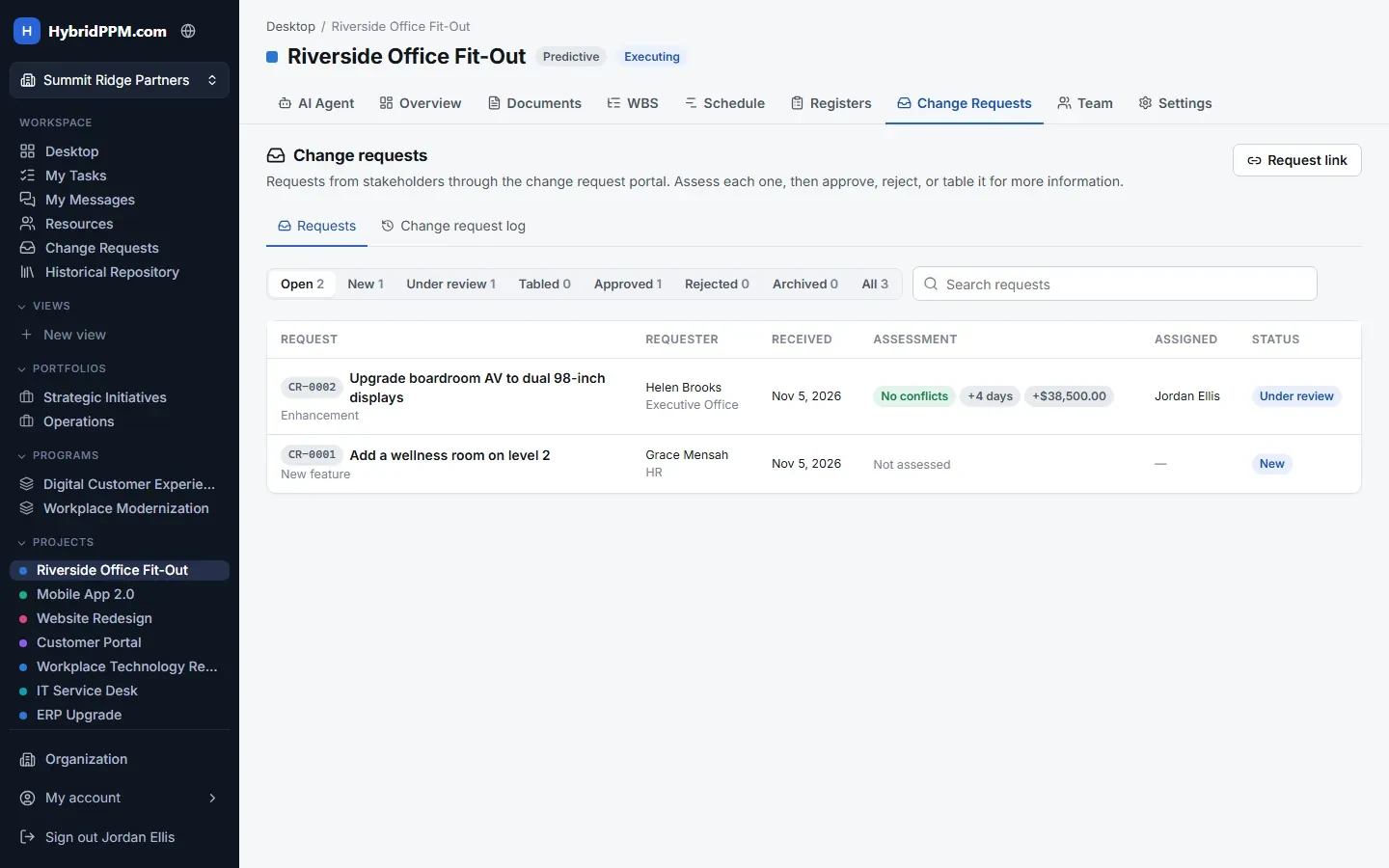
The Enterprise PMO (EPMO) is the organization-wide office that makes governance work in practice. It sits close to the executive team and connects strategy to execution across every portfolio, program and project.
- Governance: runs the gate reviews and decision forums, and keeps the decision log.
- Standards: sets the methods, templates and minimum practices each approach must follow, tailored by project type.
- Portfolio support: prepares the evidence for prioritization, funding and rebalancing decisions.
- Performance: collects consistent status, health checks and benefits data and reports them to leadership.
- Capacity: shows where people and skills are over- or under-committed across the organization.
- Capability: coaches project managers and teams, and improves the organization’s maturity over time.
Keeping it proportionate
Governance should be as light as the risk allows. Small, low-risk work needs simple checks; large, high-risk or regulated work needs more. Review the framework regularly, and remove steps that add effort without improving decisions.
PPM Governance in HybridPPM
- The Enterprise PMO: Dashboard, Governance gates, Health Checks, Planning, Performance, Capacity and Standards.
- Portfolio, program and project Dashboards, Stoplights and Status Logs feed one consistent view.
- Risk and issue registers at every level, with escalation through the hierarchy.
- Risk tolerance and decision rights, set by the Enterprise PMO under Standards.
- Every stage gate decision is recorded in the project’s Decision Log.
- Enterprise PMO → Maturity (self-assessment and service catalog) and Responsible AI (who used AI, where and for what).
- Settings → Sustainability on every project, rolled up on the Enterprise PMO dashboard.
A summary in our own words, organised around PMI’s published standards: the PMBOK® Guide, the Agile Practice Guide, The Standard for Program Management, The Standard for Portfolio Management, The Standard for Risk Management in Portfolios, Programs, and Projects, and Governance of Portfolios, Programs, and Projects: A Practice Guide. PMBOK is a registered mark of the Project Management Institute, Inc. Screenshots show a fictional demo organization.